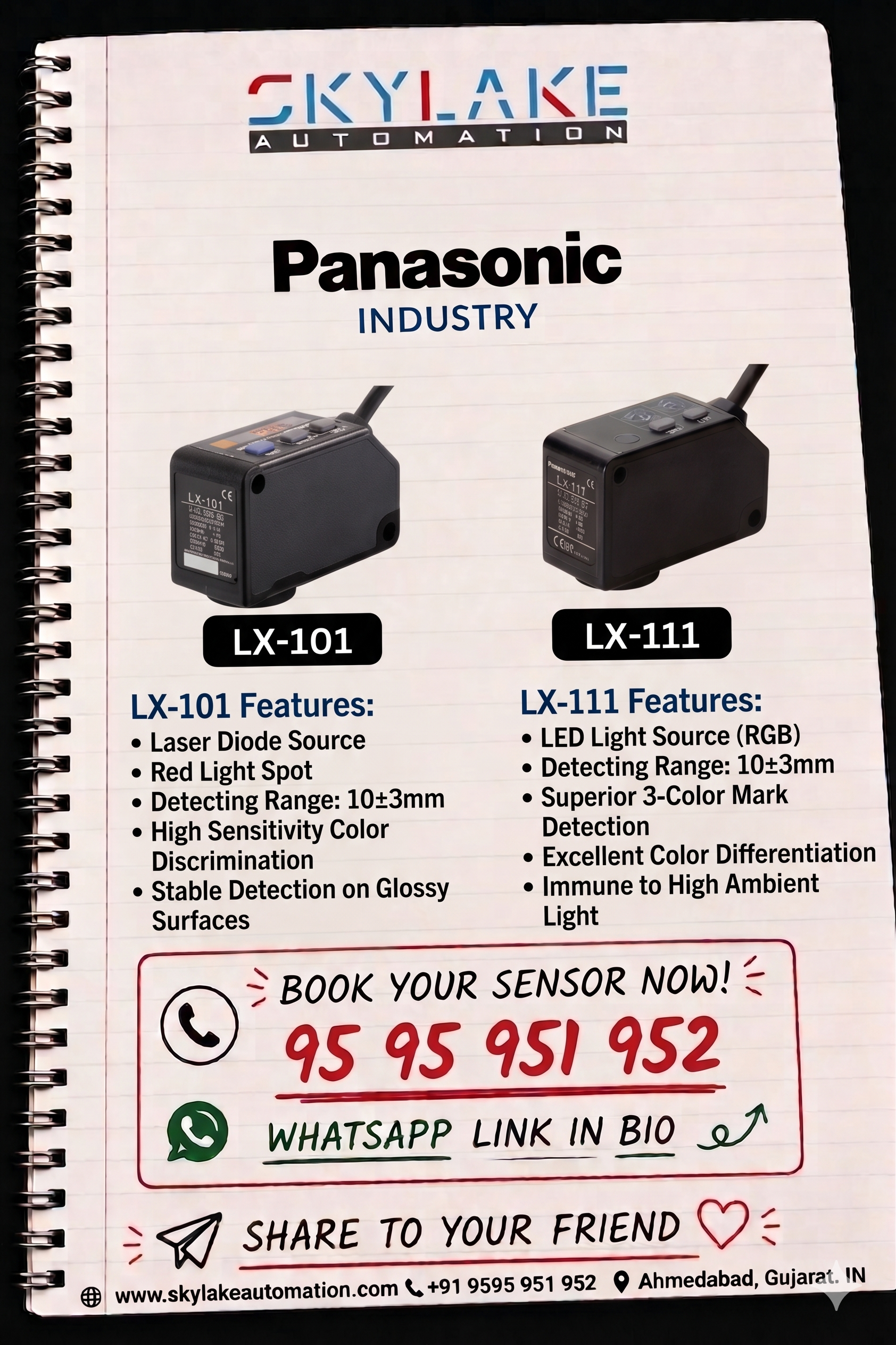
Panasonic Color Mark Sensor - LX-111, LX-111-P, LX-101-P and LX-101
The Panasonic LX-100 series (which includes the LX-101 and LX-111 families) consists of high-speed, high-precision combined LED contrast and color mark sensors. They utilize a coaxial reflective optical system with a triple Red, Green, and Blue (R·G·B) LED light source to detect print marks and distinguish minute color differentials on packaging and manufacturing lines.
Part 1: Core Differences in Specifications
The product variations are determined by two primary design criteria:
The Display Interface (LX-101 vs. LX-111 series): The LX-101 family includes a 4-digit digital LED screen for advanced configuration and live numerical readouts. The LX-111 family is a simplified version that relies on an LED indicator system rather than a digital numerical screen.
The Output Configuration (Standard vs. "-P" suffix): The base models feature NPN open-collector outputs, whereas the "-P" suffix designates PNP open-collector outputs.
Detailed Comparison Table
Specification / Feature
LX-101
LX-101-P
LX-111
LX-111-P
Output Type
NPN Open-Collector
PNP Open-Collector
NPN Open-Collector
PNP Open-Collector
User Interface
4-digit Digital Display + 6-indicator Mode Navi
4-digit Digital Display + 6-indicator Mode Navi
No Digital Display (Indicator lamps / 3 large keys)
No Digital Display (Indicator lamps / 3 large keys)
Sensing Distance
10 ± 3 mm
10 ± 3 mm
10 ± 3 mm
10 ± 3 mm
Spot Size
Approx. 1 × 5 mm
Approx. 1 × 5 mm
Approx. 1 × 5 mm
Approx. 1 × 5 mm
Emitting Element
Combined R·G·B LEDs (640nm / 525nm / 470nm)
Combined R·G·B LEDs (640nm / 525nm / 470nm)
Combined R·G·B LEDs (640nm / 525nm / 470nm)
Combined R·G·B LEDs (640nm / 525nm / 470nm)
Response Time
Mark Mode: ≤ 45 µs
Color Mode: ≤ 150 µs
Mark Mode: ≤ 45 µs
Color Mode: ≤ 150 µs
Mark Mode: ≤ 45 µs
Color Mode: ≤ 150 µs
Mark Mode: ≤ 45 µs
Color Mode: ≤ 150 µs
Supply Voltage
12 to 24 V DC ±10%
12 to 24 V DC ±10%
12 to 24 V DC ±10%
12 to 24 V DC ±10%
Dual Outputs
Yes (Output 1 & Inversion Output 2)
Yes (Output 1 & Inversion Output 2)
No (Single Output via cable/mode selection)
No (Single Output via cable/mode selection)
Timer / Advanced Pro Functions
Yes (ON/OFF-delay timer, direct 4-digit code settings)
Yes (ON/OFF-delay timer, direct 4-digit code settings)
Simplified configuration via Mode Switching input
Simplified configuration via Mode Switching input
Enclosure Rating
IP67 (IEC)
IP67 (IEC)
IP67 (IEC)
IP67 (IEC)
Part 2: Operating Modes & Functional Differences
Both sensor lines offer two distinct internal processing modes that can be selected depending on the application requirements:
Mark Mode (Ultra High-Speed Contrast Detection):
How it works: During the teaching process, the sensor analyzes the mark and the base material. It automatically determines which single LED color (Red, Green, or Blue) yields the highest contrast ratio (S/N ratio).
Performance: It locks onto that single color to achieve a 45 µs response time, making it optimized for high-speed indexing.
Color Mode (High-Precision Discrimination):
How it works: The sensor fires all three R·G·B LEDs simultaneously. It calculates the reflective light ratio using an internal 12-bit A/D converter (1/4000 resolution).
Performance: It verifies the exact color composition rather than just surface contrast, achieving a 150 µs response time. This mode prevents false triggers from reflections or variations in the base material color.
1. Form-Fill-Seal Packaging Film Synchronization (Mark Mode)
In automated packaging lines, plastic or paper film is fed continuously. The sensor detects the printed registration marks on the edge of the film to command the cutter or sealing jaws exactly between individual packets.
Why it matters: The Mark Mode's 45 µs response time handles high-velocity web pulling without drifting